
No one walks into surgery without a bit of fear. Whether it's a simple procedure or something significant, there's always that “what if” hiding in the back of your mind. What if something goes wrong?
The truth is — complications can happen. But they're not always disasters. Understanding what surgical complications mean, why they occur, and how doctors handle them can make the whole experience far less intimidating.
At Phoenix Medical Centre, Dumdum, our expert surgeons and care team ensure that every step — from pre-op preparation to recovery — is managed with precision, compassion, and safety in mind. If you're researching post-surgery complications before an upcoming procedure, this guide walks you through exactly what to expect, phase by phase.
What Sorts of Complications Can Occur?
Understanding the types of surgical complications starts with knowing when they tend to happen. Risk isn't spread evenly across your surgical journey — it shifts depending on the phase you're in.
| Phase | Common Problems / Risks | Quick Notes on Severity |
| During (intra-op) | Bleeding, injury to nearby organs, reactions to anaesthesia | Usually recognised immediately, often correctable |
| Immediately after | Shock, wound bleeding, respiratory problems, urinary retention | Critical window — close monitoring matters |
| Postoperative (days to weeks later) | Infection, DVT (deep vein thrombosis), wound dehiscence, pulmonary complications | These occur after you leave, so vigilance is key |
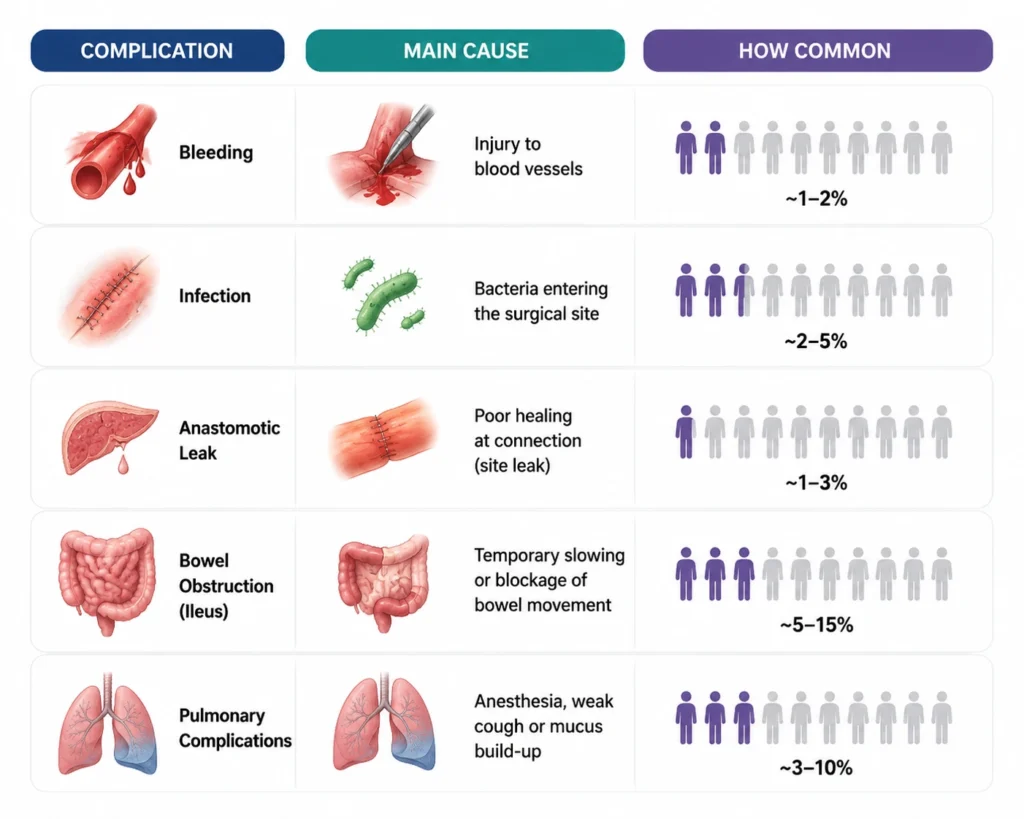
Beyond the phase-wise breakdown, here's a closer look at the individual complications themselves, what causes them, and how common they are:
| Complication | What It Is | Why It Happens |
| Bleeding/haemorrhage | Excess blood loss during or after surgery, ranging from minor to serious | Vessel injury, clotting issues, or medication interactions |
| Wound infection | Redness, swelling, discharge, or fever at the incision site | Bacterial contamination during or after the procedure |
| Deep vein thrombosis (DVT) | Blood clots forming in deep veins, usually in the legs | Reduced mobility and blood flow after surgery |
| Pneumonia/respiratory issues | Breathing difficulty or lung infection post-op | Shallow breathing, prolonged bed rest, weak post-op respiratory care |
| Urinary retention | Difficulty urinating right after surgery | Effects of anaesthesia or nerve sensitivity near the surgical site |
| Anaesthesia reaction | Allergic or metabolic response to anaesthetic drugs | Rare, but linked to individual sensitivity or undisclosed history |
| Organ/tissue injury | Accidental damage to nearby structures during the procedure | Anatomical variation or technical complexity of the surgery |
When you search “post-surgery complications to watch for,” many of these will show up repeatedly across medical sources — which is exactly why being informed in advance matters.
Surgical Error vs Complication
A complication means an unexpected outcome that can happen even with skilled care. A surgical error means a preventable mistake — like wrong-site surgery, leaving an instrument inside, or miscounted sponges. Good surgical teams track both and have systems in place to minimise errors specifically.
| Surgical Complication | Surgical Error |
| Can occur despite correct technique and full precaution | Results from a preventable lapse in process or judgement |
| Considered an accepted risk, discussed during consent | Not an accepted risk — a failure of the standard of care |
| Managed through monitoring and corrective treatment | Triggers internal review, and often legal/ethical scrutiny |
| Example: post-op infection despite sterile technique | Example: instrument left inside the patient |
If something truly preventable happens, the legal and ethical stakes rise. But most complications are not errors — they're risks accepted in advance, explained and consented to before the operation ever begins.
How Doctors Handle Complications in Surgery
Let's say you're in the shoes of the surgical team. What actually happens when a complication arises?
| Step | What the Team Does |
| Early detection/monitoring | Watch vital signs, drainage, and lab values — the sooner a red flag is spotted, the better the outcome |
| Stabilization | Control bleeding, maintain blood pressure, manage breathing, provide fluids or transfusion as needed |
| Corrective procedures | Return to the operating room if needed — to evacuate a hematoma, re-suture a leaking vessel, or repair an organ |
| Medical therapy | Administer antibiotics, anticoagulants, pain control, respiratory support, and physiotherapy |
| Close follow-up & adjustments | Reassess frequently, adjust treatment, and support nutrition and healing as part of structured post-operative care |
This is how doctors handle complications in surgery in practice. The goal at every step is the same — catch issues early and act fast to minimise harm.
Signs You Should Contact Your Doctor Immediately After Surgery
Knowing what's normal versus what needs urgent attention can make all the difference in your recovery.
| Warning Sign | Possible Concern | What To Do |
| Fever above 101°F (38.3°C) that won't settle | Underlying infection | Call your surgeon same day |
| Redness, warmth, or pus around the incision | Wound infection after surgery | Get the wound checked promptly |
| Calf swelling, pain, or tenderness | Deep vein thrombosis (DVT) after surgery | Seek urgent medical evaluation |
| Sudden breathlessness or chest pain | Possible clot travelling to the lungs, or respiratory issue | Treat as an emergency — go to the ER |
| Heavy or persistent bleeding | Inadequate clotting or vessel issue | Contact your surgical team immediately |
| Inability to urinate or abdominal swelling | Urinary retention or internal complication | Same-day medical review |
These symptoms don't always mean something has gone seriously wrong, but they warrant a prompt call to your surgeon or a visit to an emergency department — don't wait it out.
Tips for Patients: Preventing Surgical Risk & Boosting Your Safety
You're not powerless here. Knowing how to prevent surgical complications starts well before you're wheeled into the operating theatre.
| When | What You Should Do |
| Before surgery | Disclose full medical history, allergies, and current medications honestly |
| Before surgery | Stop smoking, and get blood sugar and blood pressure under control |
| Before surgery | Ask your surgeon about the common risks of surgery specific to your operation |
| Before surgery | Follow preoperative instructions carefully — fasting, stopping certain drugs |
| After surgery | Begin early mobilization as advised — walking, breathing exercises |
| After surgery | Keep the wound clean and dry, and attend every follow-up visit |
| After surgery | Report any warning signs immediately rather than waiting to see if they pass |
Recovery After Surgical Complications — What to Expect
Even after a complication, full recovery is possible. But it may be slower. You may need a longer hospital stay, extra procedures, extended physical therapy, or more intensive wound care as part of your surgery recovery care.
It's also normal to feel fear, frustration, or emotional stress during this stretch. That reaction doesn't mean something is wrong with how you're coping — it's a natural response to an unplanned setback. Support from the medical team, clear communication, and patience are just as important to recovery as the medical treatment itself.
Myths vs Facts About Surgical Complications
| Myth | Fact |
| A complication always means the surgeon made a mistake | Most complications are recognised risks of the procedure, not errors in technique |
| If you feel fine right after surgery, you're in the clear | Infection, DVT, and wound dehiscence often surface days or weeks later — follow-up matters |
| Minor surgeries carry no real risk | Even routine, minimally invasive procedures carry some risk of bleeding, infection, or anaesthesia reaction |
| Nothing can be done once a complication develops | Early detection and prompt treatment resolve the vast majority of complications successfully |
Why Choose a Skilled Team?
If you ever need a general surgeon in Dumdum, choosing a hospital that effectively handles complications is critical. At Phoenix Medical Centre, Dumdum, our general and laparoscopic surgery team brings the experience, infrastructure, and protocols needed to manage surgical complications proactively and compassionately — whether you're here for a gallbladder stone removal, an appendix removal, or a laparoscopic hernia repair. We believe in transparency, safety, and patient-centred care at every stage.
If you've been putting off a procedure out of worry, it's worth reading about the warning signs you shouldn't delay laparoscopic hernia repair — early treatment often means a simpler, lower-risk surgery. Our specialist doctors are available to walk you through exactly what to expect for your specific procedure, backed by round-the-clock post-operative monitoring.
Frequently Asked Questions(FAQ)
How long does recovery take if a surgical complication occurs?
It varies by complication type and severity — a minor wound infection may add a few days, while something like DVT or a corrective procedure can extend recovery by several weeks.
Can surgical complications be completely avoided?
Not entirely — some risk exists in every procedure — but careful pre-op preparation and following post-op instructions significantly lower the odds.
Is DVT common after all types of surgery, or only major ones?
DVT risk is higher after longer, major, or lower-limb/abdominal surgeries, but even shorter procedures carry some risk, especially with reduced mobility afterward.
How does Phoenix Medical Centre monitor patients after surgery to catch complications early?
Through structured post-operative rounds, vital sign tracking, wound checks, and scheduled follow-up visits designed to catch red flags before they escalate.
Ready for a general surgeon in Dumdum you can trust before, during, and after your procedure? Book a consultation with the surgical team at Phoenix Medical Centre.